
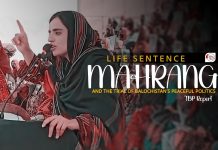















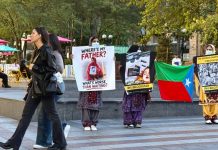


Detained Baloch Yakjehti Committee (BYC) leader Dr Mahrang Baloch has condemned the Balochistan Assembly’s decision to amend the Anti-Terrorism Act (ATA) 1997, calling it an attempt to “legitimize state repression” and create “secret, faceless courts where justice becomes a mockery.”
The amendment, titled the Anti-Terrorism Balochistan (Amendment) Act 2026, was presented by Parliamentary Secretary Mir Zareen Khan Magsi on behalf of the provincial home department, led by Chief Minister Sarfraz Bugti.
Officials said the changes were aimed at strengthening the counter-terrorism framework “in line with international standards” by providing a more secure legal framework for judges, prosecutors, defense lawyers and witnesses.
According to the bill, new measures would allow concealed identities, coded references, virtual hearings and trials held outside traditional courtrooms if required for security. The government said such steps were needed to protect those involved in sensitive terrorism-related cases.
Related: Balochistan Assembly Passes Special Anti-Terrorism Law
However, in a statement posted on X on Sunday, Dr Baloch said the law was in fact designed to silence dissent.
“This is nothing but a dangerous step,” she said. “It legitimises repression. It silences opposition voices. Our greatest fear is now coming true.”
She added that the amendment, combined with the Anti-Terrorism (Amendment) Bill 2025 passed in June, would be weaponized against “peaceful activists, political workers, and opposition voices,” stripping away the constitutional right to a fair trial under Article 10-A.
Dr Baloch warned that the measure would lead to “secret, faceless courts where justice becomes a mockery.”
Crackdowns and disappearances
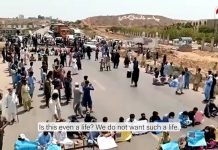
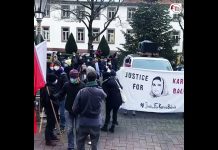
The BYC leader, who has been in detention since March, said the crackdown on peaceful political activism had intensified this year.
According to her, more than 50 operations have been carried out against BYC activists in recent months, with hundreds arrested or forcibly disappeared.
“Only in March, 147 people were disappeared. In April, 166 more. Between January and June alone, there were 814 enforced disappearances. That number is nearly equal to the total of the entire previous year,” she said.
She added: “At least 131 people have been killed without trial in the first six months of this year. These killings happened through custodial torture, staged encounters, and indiscriminate military operations.”
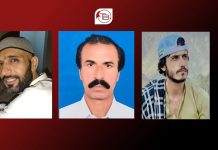
Dr Baloch said six people from Kech district were killed in targeted attacks by “death squads” in just one week of September.
“This is not a security policy. This is slow-motion genocide,” she said. “Every single day, an average of four to five Baloch are abducted. One to three are executed or killed by security forces and their allies. At the same time, state-backed private militias, locally known as death squads, have been reactivated. These groups work hand in glove with security agencies to terrorise the civilian population.”
‘A bloody war on the Baloch’
Dr Baloch alleged that the state had imposed “a bloody war” on the Baloch, using both repressive legislation and armed militias.
“The state is waging a bloody war against the Baloch, using both legal means, such as draconian laws, and illegal means, such as death squads,” she said. “Both serve the same goal: the subjugation and elimination of the Baloch people.”
She urged Baloch people to remain “steadfast, committed, and courageous” in the face of oppression.
“Our struggle is for justice and dignity; it is a legitimate cause,” she said. “Despite the state’s brutality, we will continue peaceful resistance against repression. History will vindicate those who fight for justice and dignity.”