
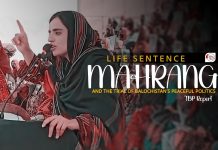












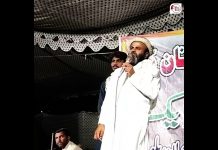



An Anti-Terrorism Court (ATC) in Quetta has extended the police remand of Baloch Yakjehti Committee (BYC) central organizer Dr Mahrang Baloch and five other BYC leaders for a further 20 days.
Dr Baloch, Beebow Baloch, Gulzadi Baloch, Sibghatullah Shah Ji, Bebrag Baloch, and Ghaffar Baloch were presented before Judge Muhammad Ali Mubeen on Saturday, following the expiry of their previous 15-day remand. Police requested an extension, which was opposed by Advocate Israr Jattak, representing Dr Mahrang Baloch, who argued there was no legal justification for it.
Police informed the court that three cases had been registered against the accused at the Civil Lines and Brewery Road police stations. After hearing both sides, the judge granted the police request and extended the remand by 20 days.
Lawyers for the six accused said the repeated remand extensions were being used as a tactic to harass their clients.
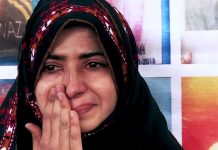
During the hearing, Dr Mahrang addressed the judge directly, saying: “Remand means that you question us, but in the past 25 days, you haven’t asked us a single question.”
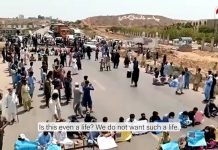
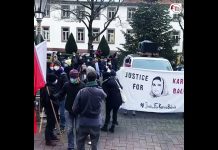
A large crowd gathered outside the court, chanting slogans in support of the BYC leadership. BYC leaders used the occasion to urge supporters to remain united and continue their struggle in an organized manner, stating that prisons and hardships cannot weaken their conviction.
Addressing the crowd, Dr Baloch said, “Islamabad cannot tolerate our ten mothers, while their generations are benefiting from this very land.” She and other leaders alleged that there is a “double standard of law” for Baloch people, claiming that judges and courts are used against them.
“We are exposing the laws and courts of this country to the whole world through our struggle,” Dr Baloch said.
“These are the tyrants who cannot tolerate our mothers in Islamabad, while their generations are permanently settled here in Balochistan. Punjab’s economy runs on Balochistan. They have settled their children here and even opened businesses for themselves,” she continued.
“But they hate us so much that a mother holding the photo of her forcibly disappeared son is not tolerated in their city,” Dr Baloch added.
BYC Condemns Court Decision
In a statement issued after the hearing, the BYC strongly condemned the court’s decision, calling it “a collusion between the judiciary and state institutions to silence Balochistan’s voice.”
The BYC said the decision not only violated “fundamental principles of law and justice” but also raised serious concerns about the “independence of the judiciary in Pakistan.”
“It has become clear that the courts are yielding to state and military pressure, strengthening the hands of oppressive forces rather than delivering justice to human rights defenders,” the statement read. “The judiciary is complicit, albeit indirectly, in the ongoing human rights crisis in Balochistan.”
The BYC further alleged that its legal challenges to the arrests have been repeatedly dismissed or transferred by the Balochistan High Court under “constant state pressure.” The group criticised the repeated extensions of physical remand, stating that under the Anti-Terrorism Act, remand beyond 14 days is only permitted with substantial evidence.
The statement added, “Courts in Balochistan are no longer delivering justice; instead, they are executing the will and conspiracies of military institutions. The judiciary’s role should be to uphold the constitution and provide justice, but in Balochistan, it is dismantling constitutional principles in a manner reminiscent of colonial-era practices.”
The BYC said the only “crime” of Dr Mahrang Baloch and the leadership was their “peaceful and democratic demand for fundamental human rights and justice.” The BYC called the terrorism charges against them “baseless” and said their detention was “a blatant violation of all international human rights and standards of justice.”
The BYC concluded by urging the United Nations, international human rights organizations, and the global community to “take immediate notice of the ongoing state repression and judicial injustice in Balochistan.”