













The Baloch Yakjehti Committee (BYC) has accused the deputy commissioner of Quetta of acting “in the manner of a dictator” after four members of the same family were allegedly forcibly disappeared for attending a Human Rights Day seminar in the city.
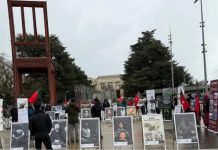
In a statement on Sunday, the BYC said an awareness programme was held on 10 December, International Human Rights Day, inside a walled venue in Quetta. The event, it said, did not block any roads or disrupt government activity. Despite this, four relatives were summoned to Sariab police station later that evening on suspicion of attending the seminar and were subsequently disappeared.
According to the statement, when a petition was submitted in court the following morning for their recovery, the judge was informed that the four were being held at the deputy commissioner’s office under Section 3 of the Maintenance of Public Order (3-MPO). The BYC said no legal documentation was provided to support this claim.
The group said the incident illustrated that “an undeclared military-style martial law” was effectively in place in Balochistan, alleging that judges and deputy commissioners were operating “in concert with the military and intelligence agencies, playing the role of soldiers in civilian clothing”.
The BYC said that holding a programme on International Human Rights Day was a constitutional right. It added that disappearing four members of one family on this basis, and then detaining them under 3-MPO without legal grounds, showed that the Pakistani state was governing Balochistan “in the manner of a colony”.
The organization said the level of repression was becoming increasingly overt, arguing that “the real perpetrators in society today are the state and its instruments”, while those imprisoned in jails and torture cells were from “oppressed and marginalised classes”.
It said every conscious individual must resist this “colonial system”, warning that in “an extreme phase of fascism, people would continue to suffer in one form or another”.
The BYC urged international human rights organizations to take “effective and practical action” against what it called state repression. Remaining silent at this moment, the group warned, would amount to “strengthening oppression itself”.
Meanwhile, Dr Sabiha Baloch, a leader of the BYC, said the arrest and disappearance of the four men, including an elderly individual and his two sons, reflected “the deepening authoritarian behaviour of the state”. She said their only “crime” was the suspicion of attending a human rights conference.
Dr Sabiha questioned the legal basis for the detentions, asking: “Which law in Pakistan criminalizes attending a human rights conference?” If no such law existed, she said, then the actions taken against the family represented “collective punishment, abuse of authority and institutionalized cruelty”.
She said the case highlighted a broader pattern in which the law was “weaponised against citizens”, administrative powers replaced due process and detention served as punishment without trial. Such actions, she added, violated constitutional protections as well as Pakistan’s obligations under international law, including safeguards against arbitrary detention and enforced disappearances.
Dr Sabiha said the system enabling these actions was reinforced by the judiciary, police administration, security forces and intelligence agencies. “When courts fail to intervene, when police execute unlawful orders, and when administrations govern through fear, the entire system becomes an instrument of repression,” she said.
She called on international institutions and donor states to review their engagement with Pakistan, warning that unconditional funding for security and governance sectors contributed to enforced disappearances, arbitrary detentions and extrajudicial killings. All international assistance, she said, should be conditioned on measurable human rights compliance.