





















By Zaarain Baloch
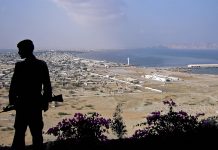
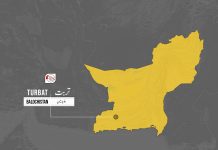
Almost 80 kilometres to the southeast of the Anjeera Cross lies Zehri, a town of almost 150,000 souls that existed quietly out of the media’s gaze, until the recent events threw it back into the spotlight. Currently under a large-scale military operation that has been going on for almost a month, Zehri holds a special place in the history of early insurgencies in Balochistan. Once the cradle of the second wave of Baloch insurgency, Zehri has, for the past year and a half, become a central stage in the ongoing struggle, ever since the Baloch Liberation Army (BLA) and Balochistan Liberation Front ramped up their presence in the town. In this short period these groups have reshaped Zehri politically and socially, carved a place for themselves in people’s collective psyche, and – by some accounts – “won hearts and minds”. This is the story of how that came to happen.
Boarding one of the minivans that run between Zehri and Balochistan’s other cities, you see many faces: a salaried worker on his way home after collecting his pay; an elderly woman and her pregnant daughter-in-law coming back from a medical visit; a young seminary student who squeezed into the van to return home for the holidays. As the minivan turns southeast from Anjeera Cross, where there is an FC checkpoint, the mood inside shifts. There is a small, collective change – the passing familiarity that comes with being closer to home becomes tangible.
As the van cruises at about 100 km/h, the mountains around Zehri make themselves visible. They run together like sand dunes in a hot desert; their slopes flow into one another so the eye cannot tell where one mountain ends and the next begins. Travelling by day, you will often see herders tending their herds as they graze on the slopes.
One detail you cannot miss is how close the main road – from Anjeera to Norgama, Zehri’s most populous and central area – runs to the mountains. The road hugs the range, which makes the high ground a natural vantage for anyone watching who moves in and out of Zehri. Although other routes connect Zehri, one through Pandran to Kalat, for instance, this main road carries the bulk of the town’s traffic.
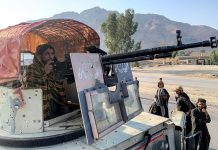
The journey gives plenty of time to think about Zehri as both a town and a tribe, and about the role the people have played in the Baloch struggle. As the road winds nearer to the mountains around Lakhorian, two armed, masked men appear by a motorcycle – a Honda CG 125 loaded with supplies. With old, torn clothes, overgrown hair and a thick beard that pushes its way out from under their masks, these are BLA fighters. They have set up what will be the first of two makeshift checkpoints along the route to Norgama.
The driver – who travels this road every day – knows the routine. He slows and stops. He greets the masked men. One of them asks if there is an outsider in the vehicle. The driver answers, “No.” The other fighter, a Balochistan flag draped around his neck, circles around the van, alert for anything unusual. There is an atmosphere of mutual recognition: the masked men expect the driver to be truthful in case there are outsiders, and the driver and passengers expect the masked men to not harm anyone without cause. With a single nod the men let the van move on.
As the minivan picks up speed, conversations spill into earshot. Men in the front engage the driver in a conversation on how Zehri has changed since the Baloch armed groups asserted control. Passengers in the back recount how the sarmachar – fighters aligned with Baloch “pro-independence” groups – have banned needless hunting of wild animals and the cutting down of trees to preserve wildlife and the small patches of greenery on the mountains. Theelderly mother-in-law tells her daughter-in-law she heard watchmen at Zehri Bazaar no longer do their night-time rounds – break-ins have become rare because the sarmachar patrol the Bazaar at night.
The minivan comes upon the Gazzan Levies Chowki for the second BLA checkpoint. A group of five armed men on three motorcycles sit by the roadside a few feet from the Levies station. The driver stops precisely where a man waiting expects the van to pause. This man, no older than twenty-five and unmasked, has a sunburned, battle-hardened face, a thick beard, long hair under a cap with “Baloch” written on it, and an M4 carbine slung over his shoulder. He fits the archetype of a Baloch guerrilla fighter, a sarmachar. I am not surprised at the location of this checkpoint – Gazzan, after all, is where the seeds of the current insurgency started germinating in Zehri. It’s the hometown of famed BLA commander Zia Ur Rehman, alias Dil Jan, and it’s where he and his companion Barag Baloch stayed up for a year, preaching the message of an independent Balochistan to any listening ear. It is where they were ambushed by the Pakistani forces, and where they breathed their last, choosing to claim their own lives rather than be taken alive in 2018. It’s arguable whether Zehri would’ve been what it is today without the two men’s work.
This checkpoint is thorough. The young fighter walks around the van and asks the passengers questions to make sure there are no outsiders. He shares a laugh with the conductor about how dirty the van is, and jokes that the driver shouldn’t pay the conductor for the day. After the brief exchange, they say goodbye and we move on toward Norgama Bazaar.
On the way, a small burnt truck, a Hino Ranger, sits in the middle of the road near Tarasani, a remnant of a battle where Pakistani forces were ambushed on August 11, leaving dozens dead. As the van passes the charred wreck, the men in the front ask what happens if an outsider is found. The driver explains the procedure: the fighters ask why the outsider is coming to Zehri, where they will stay, and for how long; they call the person who will host the outsider and make clear that host will be responsible for them. If the answers satisfy them, the outsider is allowed safe passage into the town. Otherwise, they are turned back.
After dropping a few passengers off in Balbal and Kochav, the minivan makes its way to Zehri Bazaar, where the driver and most of the passengers will get off before the conductor sets out to drop the last few passengers at their homes. As the minivan makes a tight turn near the Zehri Resthouse, one can see, a few hundred feet away, what remains of the house where Nawab Noroz Khan Zehri, the chieftain of the Zehri tribe, once lived with his household.
In 1958, the elderly Nawab, then in his eighties, led what would later become the second wave of insurgency in Balochistan against the Pakistani state. The Nawab assembled a guerrilla force numbering between 750 and 1,000 men to fight against the Pakistani forces who had arrested the Khan of Kalat, looted his palace, plundered his treasury and ancestral heirlooms, and detained over 300 other political leaders from nearby towns. This was done under the pretext that the Khan’s brother, Prince Abdul Karim – the architect of the first Baloch insurgency in 1948 – and his uncle had been secretly negotiating with Afghanistan to secure support for a full-scale Baloch rebellion and had allegedly assembled a force of 80,000 tribesmen to fight for the cause. The only piece of “evidence” put forward to substantiate these claims was that the Khan’s wife, an Afghan national, had gone to Kabul for holidays.
Baloch nationalists maintain that these allegations were deliberately fabricated to provide a pretext for the imposition of Pakistan’s first martial law on October 7, 1958, a day after the attack on Kalat and the Khan’s arrest, by President Iskandar Mirza. The Khan’s arrest, as Selig Harrison notes, touched off a chain reaction of violence and counter-violence across Balochistan. Pakistani forces began patrolling Jhalawan aggressively, ordering tribesmen to hand over their weapons to the local police. When the tribesmen refused, the army deployed tanks and artillery in Jhalawan’s towns and remote villages to force their compliance – a tactic that, analysts often point out, has not changed to this day.
For Nawab Noroz Khan Zehri, the arrest of the Khan and the looting of his palace were the tipping points. He and his sons led guerrilla operations against Pakistani forces in Jhalawan, declaring that they would continue fighting until the Khan was restored to power and the One Unit System – a political scheme devised by Pakistan’s Punjabi ruling elite to dilute regional autonomy and suppress the rising tide of separatism in East Pakistan (now Bangladesh) – was abolished. To the Nawab, the One Unit project was nothing less than an attempt to erase Baloch identity by forcing it under the banner of “Pakistani,” a term that even now remains elusive and contested as Pakistan struggles to define its national identity.
True to his word, the Nawab did not back down. He held out with remarkable endurance from the Mir Ghat mountains, where he and his fighters waged a year-long resistance. The stories of that campaign – retold countless times by the elders of Zehri – have become legend. The government bombed villages it suspected of sheltering the guerrillas, much as it continues to do today. Yet, with his small band of a few hundred tribesmen, the Nawab managed to hold off the Pakistani state for an entire year.
With no end to the hostilities in sight, the Pakistani authorities turned to Doda Khan Zarakzai, a fellow member of the Nawab’s Zarakzai clan and the father of Sanaullah Zehri, the former chief minister of Balochistan. Doda Khan was among the handful of Baloch notables who cooperated with successive Islamabad regimes. According to one widely repeated version of the story, Doda Khan pleaded with the elderly Nawab to end the battle, swearing on the Holy Quran that his demands would be met and that he and his men would be granted amnesty. The promise, made on the Quran by a fellow tribesman, convinced the Nawab to lay down arms.
As he and his men made their way down from the Anari Mountains, they were immediately arrested. As with Prince Abdul Karim’s first insurgency – when the Prince had been promised safe conduct and amnesty on the Quran in the Harboi mountains of Kalat, only to be arrested – the pledge was not honored. The Nawab and his men were tried: six of his followers, including his son, were executed, while the Nawab, due to his advanced age, was sentenced to life imprisonment in Kohlu Jail.
According to Selig Harrison’s account of the executions, the condemned men cried “Long live Balochistan!” as they went to the gallows. “One of them reportedly tied a copy of the Quran around his neck,” Harrison wrote, “shouting that if he were hanged, the Quran must also be hanged, since the government had broken its holy oath.” The elderly Nawab died in prison in 1964, a celebrated martyr to the Baloch cause.
With the stories of the 1958 insurgency still in mind, I got off at Zehri Bazaar and paid my fare to the conductor. Standing on the curb, waiting for my pickup, I saw several armed, masked men, the Baloch sarmachar, moving about, two on each motorcycle, rifles slung across their shoulders. Yet what struck me most was how normal everything seemed. People continued their errands, unbothered by the armed men in their midst. They were used to it. They did not seem to mind.
Ever since the Baloch “pro-independence” groups established themselves fully in Zehri, the town has undergone a transformation that few would have thought possible. Until recently, Zehri was synonymous with corruption and lawlessness. Thievery was routine; travelling on certain routes – like from Norgama to Mishk or Chashma – was considered suicidal after 10PM. In those days, the town was effectively ruled by local strongmen, most of them allegedly loyalists and henchmen of influential politicans. They operated like petty feudal arbiters, settling trivial disputes, like a man killing another’s sheep for grazing on his patch of grassland, while imposing absurdly high penalties on impoverished families. A single such “fine” could reach a million rupees, more than what an average family earned in four years of hard labor. The reason was simple: the arbitrator’s share was fixed at a quarter of the total penalty. The higher the punishment, the higher his personal cut.
Petty crime flourished, religious fundamentalism gained ground through local religious parties, and corruption in government offices became the only viable channel for getting anything done. Both the education and healthcare systems were collapsing under neglect. That was Zehri’s reality, until about a year ago.
Around that time, the Baloch sarmachars began quietly asserting their presence in the area. In their early days, they rarely ventured into the town except under cover of darkness, preferring to operate from the surrounding mountains. Locals say that at first their presence was only whispered about, their movements glimpsed fleetingly along ridgelines and passes. Sightings were inconsistent: sometimes a group on foot in the hills, sometimes men on motorbikes moving through unpaved tracks, sometimes a car entering the bazaar at nighttime to pick up supplies.
Over time, their presence became more visible, almost routine. People began noticing surveillance drones taking off from certain mountain points. “Almost every night, I see two or three of their drones take off from a common point,” says Abdul Nabi, a resident of villageclose to a mountain where the sarmachar had set up camp, pointing toward a faint outline of peaks in the distance. “Two or three of them rise every night, gain some altitude, and then split off in different directions.”
I ask him how he can be so sure they’re drones. “That’s what my son told me,” he replies with a shy grin. “He’s educated, unlike me, so he knows about these things.”
Do they ever fly over his village? I ask, thinking of the privacy concerns such surveillance might raise. “No,” he says firmly. “They stay close to the mountains. They never fly into the village.” I press him again – could he have missed them at night? Abdul Nabi shakes his head. “I sleep outside during summer,” he says. “If anything flew over us, I’d have seen it.”
“They’ve Won People’s Hearts and Minds“
Sameer runs a hardware store in Zehri’s main bazaar. I sit across from him on a small wooden bench, sipping tea while he finishes with a customer who has come looking for a particular gauge of copper wire. The shop smells faintly of machine oil and dust; spools of wire, plumbing fittings, and metal tools hang in careful disorder on the walls.
Earlier, Sameer had been telling me how bike theft and shop break-ins were once routine in Zehri’s bazaar – so frequent, he said, that no one expected stolen property to be recovered. That was before the Baloch sarmachar took control of the town. “Now the watchmen sleep at home,” he had said before the interruption. “The sarmachar patrol the bazaar several times every night. They’ve told the watchmen they can rest peacefully; ‘we’ll watch over your shops.’”
When the customer leaves, Sameers resumes the conversation. He tells me how one night, during the Eid season, a shopkeeper had mistakenly left his store open, thinking his brother was inside and would close it later. Only when he returned home did he realize his brother was already there – and the shop still unlocked. He rushed back to the bazaar in panic, imagining the worst. But when he arrived, he found the shutter down, guarded by two sarmachar. They had noticed the open shop during their nightly patrol, gone inside to check for the owner, and when they realized it was empty, had closed it up themselves and stood watch until the owner returned.
When Sameer finishes with a few more customers, we head out together for Friday prayers at the nearby mosque. He pulls his shutter down but doesn’t bother locking it. “It’s fine,” he says as we hurry off, the call to prayer echoing across the marketplace.
On the way, he points toward the charred shell of what was once the NADRA office – burnt down by the BLA in January. A little further ahead, just beside the mosque, stands the levies station, also torched and sacked that same day. These ruins sit quietly in the afternoon light, mute markers of a day the town still remembers vividly.
After the prayer, as we step out into the onto the road, Sameer tells me that bikes used to vanish from this very spot during Friday prayers. “The last bike stolen from here was over a year ago,” he says. “Ever since they [the sarmachar] came, there hasn’t been a single theft. No break-ins, no burglaries, no shoplifting – nothing.”
As we make our way back through the bazaar, I begin to recognize corners and storefronts from videos I’d seen of BLA fighters addressing small gatherings here. Sameer continues talking, explaining how the shopkeepers have learned to deal with the sarmachar. “The bakery owners don’t take money for the cold drinks they buy. The meat sellers give them meat at half price. The tailors don’t argue when the sarmachar want clothes already promised to other customers. The shoe shops sell them chawat [traditional Balochi footwear] for one-third of the price.” He pauses for a moment, looking down the street. “They’ve won people’s hearts and minds in just one year,” he says finally, as we reach his store again.
“People Are No Longer Afraid“
Sitting with Abdul Rasool at his baitkhak, I can tell he is tense, his eyes darting from me to my companion every few minutes. The air is heavy with dust and tobacco smoke. He sits cross-legged on a coarse mat, his hands restless, the lines on his face deepened by age. He is the victim of a targeted raid on his house – one in which several of his family members, including two sons, were taken away by security forces. His unease is understandable.
My companion senses his hesitation and reassures him that I am here only for journalistic work, that his identity will remain protected. After some persuasion and long silences, he agrees to talk, though the reluctance lingers.
“They came around noon,” he begins quietly, staring at the ground. “Several vehicles. They knew my house like someone who had lived here for a year: every room, every bathroom, even where my sons sleep.” He pauses, his voice trembling. “They called my children and my wife by name. They went straight for my sons.”
He describes how the forces ransacked the house, terrifying the children, striking the women, overturning cupboards and bedding. But what stays with him most is what they did to his father, an elderly, retired schoolteacher suffering from dementia. “He was performing ablution for the afternoon prayer,” Abdul Rasool says, his voice breaking. “They kicked the bathroom door open, dragged him out before he could tie his trousers.” He wipes his eyes, his hand trembling as he reaches for his tea.
I ask him how he thinks the raiding party knew so much about his home and family. “There was a masked man with them,” he says. “In plain clothes. He was showing them around, whispering about us in their ears.”
It’s a detail I’ve heard before – the presence of an informant accompanying the forces during house raids, guiding them from room to room. I ask if he knows who the man was. He chooses to stays silent. I don’t press him further.
We thank him for his hospitality and step out into the fading afternoon light. On the ride back through the dry, winding road, my companion tells me that the informant that day was Hafeez Haroonzai – a stationery shop owner and member of Zehri’s levies force. He tells me how the Baloch sarmachar later found out about Hafeez’s role as an informant and took him into custody. Under interrogation, Hafeez reportedly admitted to passing information to the security forces and helping identify dozens of homes during raids. On the night of Eid-ul-Fitr, his family was informed by the BLA that he had died from a stress-related heart attack while in custody.
Other examples of alleged informants brought to justice by the sarmachar include Rahmatullah Jattak and Munawwar, both said by the BLA to have worked for Shafiq Mengal’s death squads. The group accused them of involvement in enforced disappearances, extrajudicial killings, drug trafficking, and other crimes across Zehri, Khuzdar, Kalat, and Pandraan. Both men were later killed, and their families notified.
As we drive, I ask my companion how the people of Zehri view these killings. He takes a moment before answering. “People are relieved,” he says finally. “Everyone knew who these men were, but they were untouchable. No one dared speak against them. Now, with the sarmachar here, people are no longer afraid. They pass information willingly. They see it as justice – maybe rough, but the only justice they’ve ever had.”
“Cooking for Them is the Least I Can Do“
It’s been almost a year since Taimur got married, and you can still tell from the way his room looks. The wedding takht (a mattress-like padded platform for groom and bride to sit on in Balochi weddings) is still bright and spotless, its red velvet unwrinkled, and the plastic roses are still taped to the wall exactly as they were on his wedding day. He smiles as he notices me looking at them. “My wife won’t let me take them down,” he laughs.
Taimur tells me how the women in Zehri are among the most grateful for the presence of the sarmachar. “They can go to the Bazaar without fear now,” he says. “Before, they’d have to think twice, especially after sunset. Now they walk freely.” The constant patrols of the Baloch sarmachar near the shopping centers, he says, have driven away the men who used to linger there to harass women.
“The women have their own ways of thanking the sarmachar,” Taimur says. He glances toward his wife, Shagufta, who is sitting beside us, her dupatta loosely wrapped, a shy smile on her face. “She cooks good food once a week,” he continues. “She makes one of the kids stay outside the gate to stop the sarmachar whenever they pass by so she can hand it to them.”
I ask Shagufta how it feels to speak to the Baloch fighters. “It’s a wonderful experience,” she says. “They’re very respectful. They always call me baji – sister – and thank me for my help. They tell me they live on dry bread most days, so when they get something nice to eat, it feels like a feast.” She says the sarmachar often tell her that one day their sacrifices will bear fruit, and Balochistan will be free again. “They give everything – their lives, their families – for that dream,” she says softly. “Cooking them a good meal is the least I can do.”
The End of the Meers’ Reign
The sarmachars’ arrival has not only changed the atmosphere of fear in Zehri but also upended the old social order. Before they came, power was organized along rigid tribal and class lines. Zehri’s elders would tell you that tumandars like Nawab Noroz Khan, loyal to the Baloch cause and their people, no longer exist in Zehri. What’s left are greedy local chieftains, political middlemen, and meers – many of them loyal to influential politicians – who preside over their personal courts, often held in their baithaks. There, disputes were “settled” through a system that mixed tribal custom with extortion. Whether it was a murder, a land dispute, or a quarrel between farmers, the meer would summon both parties, sometimes without even being asked to, to settle the case and hastily impose a penalty. One quarter of that fine would go directly into his own pocket. The harsher the penalty, the greater his reward. Justice, in that system, was a transaction.
One of the countless men caught in that web is Khan Jan, a thin, short, weary-looking father of three who works as a tenant farmer on another family’s land. He gets one-fourth of the profits from each harvest, barely enough to feed his family, let alone save. His story begins with a single dead goat.
“He’s a careless man,” Khan Jan says of his neighbor, wiping sweat from his forehead. “I told him many times not to let his goats into my field. They eat the crop, and the owner gets angry at me.” One afternoon, after finding the goats grazing in his wheat again, he lost patience. “I ran out, shouting, and threw my stick to scare them. It hit one goat on the head. The poor thing died where it stood.”
The neighbor, furious, went straight to a local meer from the Zarakzai tribe, a man known for settling disputes and collecting heavy fees for his arbitration. The meer, more than happy to intervene, sent his men to bring both parties to his house. Within an hour, he had “solved” the matter: Khan Jan would pay one million rupees in compensation, a quarter of which the meer would keep.
“I barely make two hundred thousand in six months,” Khan Jan says, shaking his head. “How can I pay a million?” He has spent three years paying off part of the debt, scraping together 400,000 rupees, but he still owes 600,000. “Sometimes I think it would’ve been better if I’d hit the man instead of his goat,” he mutters, a wry smile crossing his face before fading again.
Another cruel system that the arrival of the sarmachar has reportedly brought to an end to was the forced servitude of women. According to locals, members of the certain clans – long powerful and influential in Zehri – had devised a practice that exploited young couples who fled their families. The meer would offer them refuge: the man would be armed and kept as an unpaid guard or fighter in exchange for protection, while the woman was forced to work as a servant in the household without pay.
When the woman bore a child, the meer would decree that if it was a boy, the couple could keep him, but if it was a girl, she would be taken under the meer’s “care.” These girls would grow up in the meer’s house as servants like their mothers before being married off to men of his choosing – with the condition that their daughters, too, would belong to him. Over time, this cycle of servitude became institutionalized, with desperate families giving up their daughters in exchange for protection.
The arrival of the Baloch sarmachar, I learned, disrupted this entire system of exploitation. They declared that no disputes could be settled in this way and warned that anyone attempting to continue such practices would be punished. The announcement sent shockwaves through the town. The first to flee Zehri were the local sardars and meers, fearing accountability for years of abuse and exploitation.
Residents say the sarmachars’ arrival changed the atmosphere in Zehri and disrupted the town’s long-standing tribal hierarchy.
According to several locals, the fighters declared that disputes could no longer be settled under that system and warned of consequences for those continuing such practices. The announcement, people said, prompted local sardars and meers to leave the area, fearing accountability for years of “abuse and exploitation.”
Zehri Under Siege
In the year and a half of their presence, the Baloch sarmachar established their own system of control in Zehri. Many residents said they saw improvements in public safety and limits on the influence of meers and sardars—functions that state institutions had long neglected.
Alleged known criminals were brought to justice, and for the first time in years, residents said they felt safer in their own homes.
During the period that Zehri remained under the sarmachars’ control, Pakistani forces made several attempts to dislodge them, all ending in “failure”. In one instance, the Assistant Commissioner of Khuzdar entered Zehri with a large contingent of troops under the pretext of distributing aid and ration. The sarmachar surrounded the resthouse where the troops were stationed and held them at crosshairs from the roofs of nearby shops throughout the night before allowing them to leave the next morning. In another encounter, on August 11, the sarmachar ambushed and decimated a large contingent of forces entering Zehri – the charred remains of their convoy I’d seen earlier on the road.
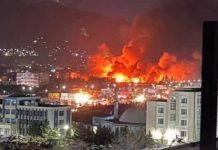
After repeated “failures” on the ground, the security apparatus turned to drones. Nearly nineteen people have been killed in drone strikes in Zehri so far, with the number continuing to rise. On September 27, the military launched a major offensive into Zehri, supported by gunship helicopters, armored vehicles, and tanks. The town has since been under siege. All routes in and out have been sealed, cutting residents off from the outside world. Internet and phone services have been suspended, making it almost impossible to verify the extent of destruction. The few visuals that have emerged paint a grim picture: women and children killed; crops burned; cattle and grain looted; the hospital converted into a military camp; shops and hotels set ablaze; people disappeared; and schools sealed shut.
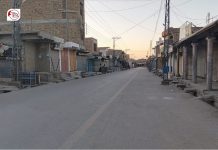
A strict curfew has been imposed, with soldiers reportedly ordered to shoot anyone seen outside after dark. Zehri’s once-busy Bazaar has been shuttered for weeks. Local sources say it has opened briefly on a few occasions – only for two or three hours – and that residents are forced to park their motorcycles and vehicles several kilometers away before entering on foot. Reports have also surfaced of patients dying because they could not access medical care: clinics remain closed, the hospital is occupied by soldiers, and all exit routes from Zehri are blocked.
During my brief stay on the ground in Zehri, I spoke with people from many walks of life –housewives, tenant farmers, shopkeepers, teachers, even children. One common thread running through all these conversations was hope. I could sense that the people of Zehri, who had long suffered under the weight of local sardars and meers, had finally tasted freedom –and they loved it. They had thrown off the chains and, for the first time, felt free.
As I got into the minivan for my return, I couldn’t help but miss what I had witnessed, a town experiencing what many described as their first respite from long-standing fear and oppression. As the vehicle cut through the morning light, I opened the window beside me to let in the fresh air, the last few gulps from a town emerging from what some of them term as suffocation. I looked out toward the majestic mountains and wondered about the secrets they held.
Then, the minivan began to slow down on the deserted road. Ahead, a checkpoint appeared, one set up by the Baloch sarmachar. The van stopped. The usual greetings followed. One of the fighters leaned in to look at the passengers, then circled around to my side.
“Qurbaan pin na der a?” (“Dear, what’s your name?”) he asked.
I told him my name. He nodded and signaled to the driver in the side mirror that we could go. As the van rolled forward, I kept my gaze fixed on the mountains, a quiet nostalgia settling in.
In what felt like a heartbeat, we were back at the Anjeera Checkpoint. With Zehri fading into the mountains behind me , I kept thinking of the town, a place that, for a brief period, replaced one form of control with another — though many residents felt it brought order, security and peace. As we left, I kept wondering what that peace truly meant, and what price it demanded.
Names and certain identifying details have been altered in this report to protect the privacy and safety of the individuals featured.