

















The Baloch Liberation Army (BLA) on Friday issued a detailed statement on Thursday’s suicide attack on a Pakistani military convoy in Balochistan’s Kech district. The group said three fighters from its “self-sacrificing unit” Majeed Brigade carried out a “precise and deadly” operation, claiming to have killed 32 military personnel, including senior officers, and destroyed more than three buses.
BLA spokesperson Jeeyand Baloch said the “fidayeen operation” was carried out at Konchati Cross in the Dasht area, where a convoy of six buses carrying dozens of military personnel, along with escort vehicles, came under attack. The convoy had travelled from Karachi to Gwadar the day before and was en route to Turbat when it was struck.
The group said the assault began at about 1:05 p.m. after what it described as “systematic planning, vigorous intelligence preparation and full military discipline,” intended to deliver a decisive blow at a moment of “enemy negligence.”
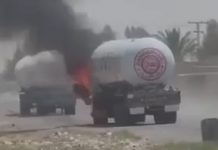
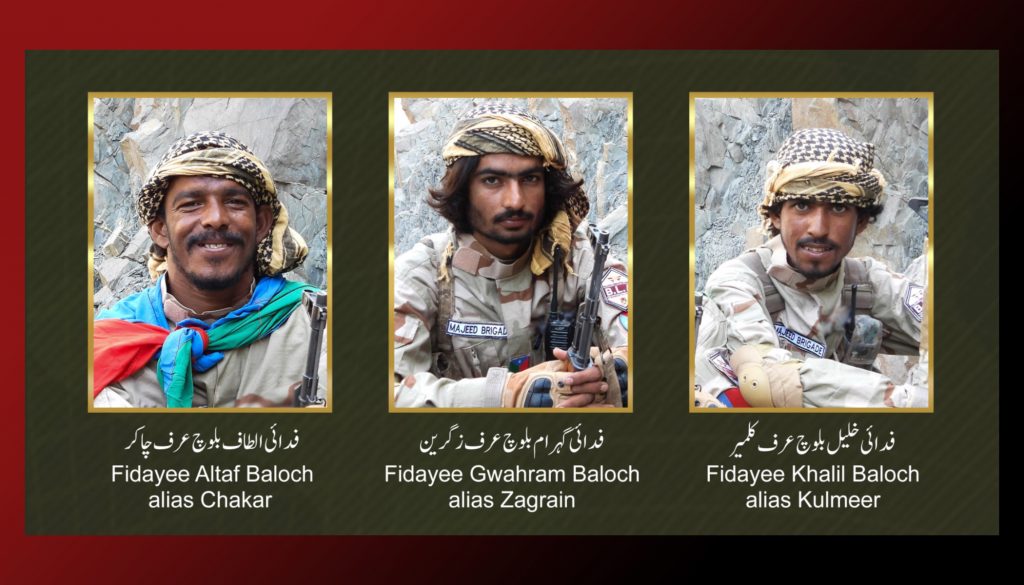
According to the statement, the first stage of the operation began when a fighter identified as Altaf, alias Chakar, rammed an explosives-laden vehicle into the lead bus of the convoy. The resulting blast, it claimed, “completely destroyed the bus and eliminated all onboard instantly.” Immediately afterwards, two more fighters, Gwahram alias Zagrain and Khalil alias Kulmeer, stormed the convoy formation and attacked the remaining buses and the accompanying security squad.
The BLA said the firefight lasted for more than 30 minutes and paralysed the movement of Pakistani forces. Despite retaliatory fire, the attackers continued until they exhausted their ammunition. At that point, the group said, they followed its principle of “the last bullet, sacrificing their lives on their nation and soil.”
According to the BLA’s own ground sources and its intelligence wing, Zirab, at least 32 Pakistani soldiers were killed, including several officers, and dozens more were injured. It said more than three buses were destroyed.
The group added that Pakistani forces faced hours of difficulty retrieving bodies and evacuating the wounded as aerial reinforcements, drones and ground troops arrived. The delay, it said, meant “most of the injured died on the spot.” The attack, the BLA argued, was “a practical expression of the belief that the enemy will not be allowed peace in any corner of Balochistan.”
The group’s media channel, Hakkal, also released a video of the attack. It shows the convoy moving before a large explosion engulfs a bus. Subsequent scenes capture gunfire around halted vehicles and wreckage. Fighters can be heard urging each other not to let buses escape, saying several had been hit and that one was “completely destroyed.”
The BLA said the attack came as Pakistan and China were intensifying efforts to increase military, diplomatic and legal pressure against the Baloch movement. It pointed to the joint bid submitted to the UN Security Council’s 1267 Committee to blacklist the BLA and its Majeed Brigade.
That proposal was blocked on Friday by the United States, United Kingdom and France, who placed a technical hold on the request and said the evidence did not meet the legal threshold required to link the group to al-Qaeda or ISIL. Pakistan and China had argued the BLA operated from camps inside Afghanistan and carried out cross-border attacks, but Western members said the material provided was insufficient.
The BLA described the failure of the proposal as a “diplomatic defeat” for Islamabad and Beijing, saying it exposed what it called the “weakness of Pakistan’s narrative.” It argued that the rejection showed there was no international consensus on labelling the Baloch struggle as terrorism.
“The attempt to portray us as linked to al-Qaeda or ISIS has collapsed under international scrutiny,” the statement said. “Our movement is organised, ideological and politically grounded. It cannot be confined to the category of terrorism.”
The BLA also paid tribute to the three fighters who carried out the attack. Altaf, alias Chakar, was said to be from Buleda’s Alandur area, Gwahram, alias Zagrain, from Panjgur’s Paroom, and Khalil, alias Kulmeer, from Turbat’s Saami area. All three joined the group in recent years and were described as embodying the “conscious resolve” of fidayeen fighters.
The BLA said its operations were a form of “legitimate national resistance” against an “occupying state,” and claimed they were carried out in line with international humanitarian law. It said unlike Pakistani forces, its units did not target civilians, public property or non-combatants.
According to the group, its strategy was focused on military forces, convoys, checkpoints, intelligence networks and collaborators. It argued that “an occupied state has no right to peace, nor can it claim neutrality amid exploitation,” warning that wherever the Pakistani military was present in Balochistan, “intense attacks and resistance will continue.”
The statement said no highway, convoy or checkpoint in Balochistan would be safe while the region remained under what it called occupation. It added that the movement had “entered an irreversible phase” where every attack was “a deliberate decision” and every fidayee was “not just a fighter but a revolutionary figure.”