
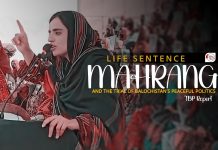







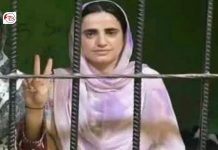
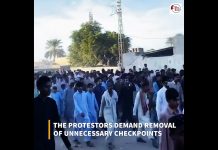


In an article written from her prison cell in Quetta’s Hudda Jail, renowned Baloch rights activist Dr Mahrang Baloch has accused the Pakistani state of targeting peaceful dissenters through imprisonment, smear campaigns, and enforced disappearances. Her article was published by TIME magazine on Tuesday, 10 June.
Mahrang Baloch writes: It has been more than two and a half months since I was thrown into prison—Hudda Prison, in Quetta, Pakistan, the same place father was caged nearly two decades ago, also for promoting the rights of the people of Balochistan.
Since my arrest, Pakistan’s state secuity agencies have deployed every tactic to break me. I have been offered a deal: stay silent, avoid political activity, and you can be home. I refused. The state has failed to produce a single piece of evidence linking me to any act of violence or criminality. The only “proof” they cite is a press conference I gave a few days before my March 22 arrest.
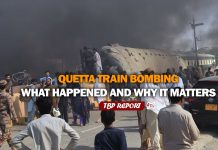
I spoke to reporters after armed militants had hijacked a train and held 300 passengers hostage for hours. The attack occurred in the Balochistan, the largest province in Pakistan, and was carried out by Baloch separatists who have been fighting with the state for decades. At the press conference, I spoke not to defend the hijackers—our movement, the Baloch Yakjehti [Unity] Committee, has always renounced violence. Indeed, my intention was to draw a distinction between those who confront the state with arms and those who confront it with words.
It’s a crucial distinction, one the state prefers to blur. In Pakistan, “terrorist” is a label pinned on anyone who advocates for Baloch rights. Those who speak up run the risk of arrest by military and intelligence agencies. After their arrest, they might never be seen again. If they are, it is often as a body, produced after a violent incident like the train attack.
This was why I asked reporters: Who were the more than two dozen “unidentified” bodies brought to Quetta’s Civil Hospital after the hijacking? And why were 13 of them buried overnight without being named? The attackers, the Baloch Liberation Army, had released pictures and details of the 12 militants it said were killed. The identities of the rest were a mystery, but we had our suspicions. In Balochistan it is common practice, after violent episodes, for the forcibly disappeared persons to be put to death, and their bodies produced as those of militants.
I demanded DNA testing of those who had been buried in the dead of night. Families of the disappeared feared, with good reason, that their loved ones were among them.
So I am in jail for insisting on the distinction between peaceful activism and violence.
My work had already drawn unwelcome international attention. In May 2024, Pakistani officials were outraged after I visited Norway at the invitation of PEN Norway, the Norwegian branch of PEN International and the World Expression Forum. I was even harassed on Norwegian soil by individuals linked to Pakistan’s embassy in Oslo, whose intervention was ended by the Norwegian domestic security agency, PST. When I returned to Pakistan, I was immediately charged with sedition, and treated as if I had returned from an ISIS camp in Syria or Iraq rather than one of the most peace-loving countries in the world.
In October, the government’s smear campaigns amplified with my inclusion on the TIME100 Next Emerging Leaders. I was called “Malala 2” and a Western puppet. Surveillance around me intensified, and I was placed on the Fourth Schedule, an anti-terror watch list typically reserved for hardened militants, and which restricts the movement and activities of the listed. I was barred from travelling abroad.
I am learning the price of peaceful activism.
For decades, Pakistan has kept the rest of the country, and the world, in the dark about Balochistan. It remains an information black hole. Among those the military and intelligence agencies have forcibly disappeared, killed, or forced into exile are journalists who dare to write about these atrocities. According to the Balochistan Union of Journalists, more than 40 have been killed since 2000. Foreign media are denied access to the region.
From this darkness, a woman leading a grassroots movement for Baloch rights was unacceptable. The hostility of the state intensified with the BBC’s 100 Women list, and a nomination for the Nobel Peace Prize. But if international pressure has prevented my being killed, I face psychological warfare, threats, and the constant spectre of danger.
I write this the day my sister told me that the Islamic State of Khorasan (ISIS-K) released a 100-page Urdu-language booklet accusing me of being a Western agent. Their “evidence”? The TIME honor and Norway trip. Other BYC leaders are in jail with me: Sabghat Ullah Shah Jee, Beebarg Zehri (a disabled man), Gulzadi, and Beebow. I tell them: We are not the first to be imprisoned for demanding peace, justice, and rights. From Nelson Mandela to Narges Mohammadi, we walk the same path. We draw strength from their courage, intellect, and defiance.
Our movement is rooted in peace. We speak against enforced disappearances, extrajudicial killings, forced displacement, and the systematic denial of basic rights to the Baloch. We are the rightful owners of the Saindak Copper-Gold Project (worth billions of dollars, but the profits are not shared with the local population), the Reko Diq mine (estimated to hold copper and gold reserves worth over $60 billion, but the benefits are not reaching the Baloch people), and Gwadar — the gateway to the China-Pakistan Economic Corridor. Yet, 70% of Balochistan’s population lives below the poverty line.
The state is offended and brands us terrorists and violent. But we are not violent. The state is armed, powerful, and ruthless. It uses violence to silence those who ask for justice. The practices once reserved for the Baloch, considered lesser citizens, are now expanding to other parts of Pakistan. Former Prime Minister Imran Khan and his party are now under the military’s wrath. He is jailed. Is Imran Khan also a terrorist? Are members of his PTI party now “agents of hostile agencies”?
If the Pakistan Army and its intelligence agencies are as competent as they claim to be, why have they failed to present a single piece of credible proof? Why have they not held a fair, transparent trial?
Because this isn’t about the law; it’s about fear, their fear of our truth.
This prison is more than bricks and bars. It carries the memory of my father. As a child, I visited him here. I didn’t grow up playing with toys. I grew up holding posters of my father, who was detained and then disappeared. When I turned eighteen, I received his lifeless, tortured, bullet-riddled body. This is not just my story. It’s the story of every child in Balochistan. Childhood here is shaped by grief, fear, and posters of the disappeared.
When our generation came of age, those of us raised in the shadows of state violence, we vowed: No child after us should suffer the same fate. We are fully aware of the power imbalance between us and a nuclear-armed state. It controls the media. It runs smear campaigns. It weaponizes the judiciary. It deploys overwhelming force. It controls the parliament. It operates proxy groups and armed militias.
Our confinement is part of a war of narratives.
Speaking up for justice is not a crime.
Raising our voices against state violence is not treason.
Demanding rights is not terrorism.
It is humanity.
And one day, we believe, this struggle will succeed.