









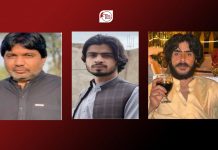










A Baloch woman has been forcibly disappeared by Pakistani security forces in Quetta, according to her family, in what they describe as the latest in a long pattern of state repression.
The woman, Mahjabeen Baloch, 24, was reportedly detained from Quetta Civil Hospital by Frontier Corps personnel and intelligence officers in the early hours of Thursday. Her whereabouts remain unknown.
Mahjabeen, a Library Science student at the University of Balochistan, was temporarily staying at the hospital due to a lack of space in the university hostel. Family members said she is a polio survivor and has a disability in one leg.
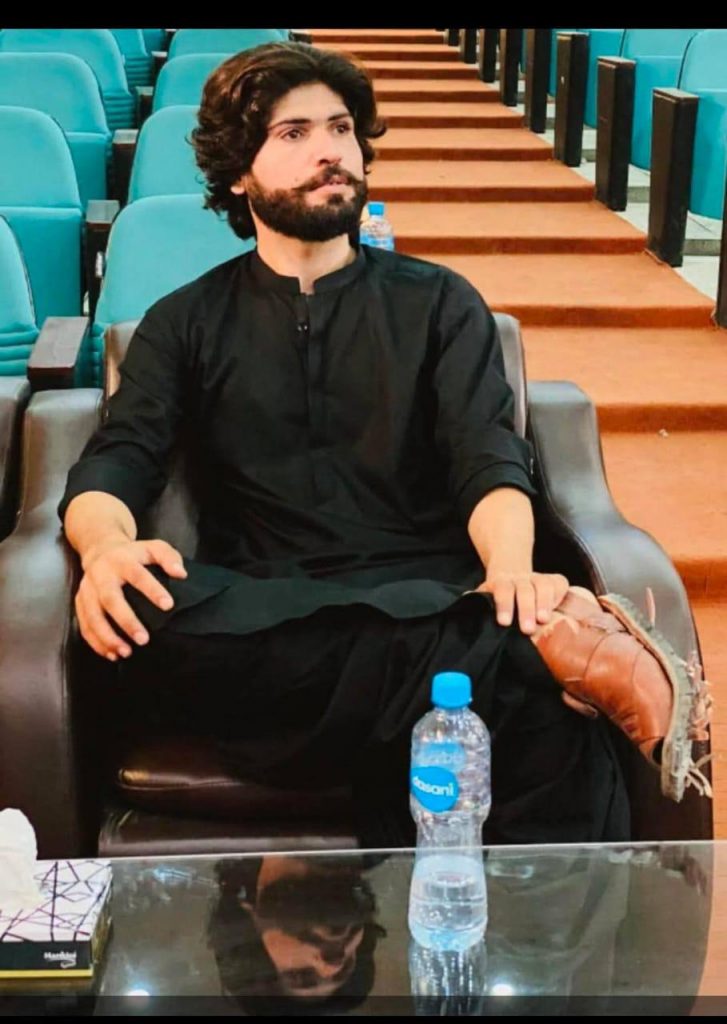
Her family said this was the second incident in a week. Just days earlier, Mahjabeen’s brother, Muhammad Younus, an engineering student at Khuzdar Engineering University, was also taken from their home in Basima by CTD and ISI officers during a night raid.
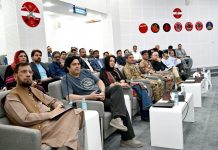
Speaking during a press conference at the Quetta Press Club on Thursday, the family said they had “endured years of state repression,” including raids, detentions, and killings of relatives.
“Our homes have been raided repeatedly by security forces. Our loved ones have been taken from their beds and their mutilated bodies dumped in desolate places,” the statement said. “Many still remain lost in the darkness of enforced disappearance.”
Family members said they had initially stayed silent, hoping for their loved ones’ safe return. “We did not protest; we remained silent in the belief that, being innocent, they would soon be released,” they said. “But our silence was taken as weakness.”
The family expressed particular concern for Mahjabeen’s case, describing the abduction of a disabled student as “an act of brutality that shatters the dignity, safety, and future of an entire community.”
“Is seeking an education a crime? Is remaining silent a crime? Is being Baloch a crime?” they asked.
The family also recalled past tragedies. In 2013, Mahjabeen’s elder brother, Yousuf Baloch, was killed during a military operation in Kallan, Kharan district, along with two other relatives, Zafar Baloch and Halkima Baloch.
They demanded the immediate release of Mahjabeen and Muhammad Younus and called on the state to end the practice of enforced disappearances. “Guarantee the right to life for Baloch students, women, and ordinary citizens,” the family urged.
They appealed to the media, civil society, and human rights organisations to “become our voice” and said: “When voices are silenced, injustice gains strength.”
Meanwhile, the Baloch Women Forum (BWF) condemned the incident, describing Mahjabeen’s disappearance as the latest example of a growing pattern of “state violence against Baloch women.”
In a statement, BWF said Baloch women, like men, are now under constant threat of enforced disappearances, and that Mahjabeen’s case shows how women are being “deliberately dragged into such offences, which is contrary to national norms, culture, traditions, honour, and the dignity of the Baloch.”
BWF added that the practice of enforced disappearances, previously targeting men, was now engulfing Baloch women from other spheres of life, describing the situation as “alarming for us as a nation.”
The group said: “We demand the immediate and safe release of Mahjabeen Baloch and accountability for her abductors.”
The human rights department of the Baloch National Movement (BNM), Paank, also condemned the incident, calling it a “clear violation of fundamental human rights and an attack on academic freedom.” Paank said Mahjabeen’s disappearance was part of an “ongoing and deeply troubling pattern” of state-led abductions in Balochistan.
Paank called on the authorities to “end the culture of impunity, ensure accountability, and respect the basic rights and dignity of all citizens.”
The group demanded the immediate and safe release of Mahjabeen, warning that the case has once again brought international attention to the worsening human rights situation in Balochistan.
Dr. Sabiha Baloch, a leader of the Baloch Yakjehti Committee (BYC), said Mahjabeen’s case reflected the daily reality faced by Baloch women and students. In a post on X, Dr. Baloch said that a disabled Baloch girl “deserves a medal for her struggle”—simply for the courage it takes to attend university, return to her hostel, and survive each day.
Dr. Baloch said the enforced disappearance of such students was an attack not just on individuals but on an entire nation’s hope for a future. “This is not the story of a single individual,” she wrote. “It is the collective life of the Baloch: pain, resistance, and a struggle for survival whose outcome remains shrouded in uncertainty.”
The National Democratic Party (NDP) also called Mahjabeen’s disappearance “an unacceptable state action” and said it “must be met with unyielding resistance”. In a statement, the NDP said the enforced disappearance of a female student like Mahjabeen was a “blatant violation of Pakistan’s Constitution, Baloch cultural values, and international human rights law”.
The NDP spokesperson said that “for years, Baloch men—elderly and young alike—have faced enforced disappearances”, and warned that this “cruel trend has now extended to Baloch women”.
The party demanded the government and security agencies immediately produce Mahjabeen in public view and hold those responsible to account. It also urged international human rights groups, journalists, and activists to raise their voices against enforced disappearances in Balochistan.
The Human Rights Council of Balochistan (HRCB) said it “condemns these abductions, expresses deep concern, and demands their immediate release”. The group added that “if there are any charges, they must be produced before a court of law”.
Human rights groups have long raised concerns over enforced disappearances in Balochistan. They say students, activists, and civilians have been forcibly taken over the years, with Baloch women increasingly becoming targets.
In a recent joint letter to Prime Minister Shehbaz Sharif, five global rights groups—including Amnesty International, Front Line Defenders, and FORUM-ASIA—warned that Baloch women were facing unlawful detentions and enforced disappearances.
The groups described the arrests of Baloch Yakjehti Committee (BYC) leaders, including women activists, as part of a “systematic attack” on Baloch civil resistance.
The organisations called for an end to the targeting of Baloch human rights defenders, the immediate release of all detained activists, and accountability for state actions that they say have left women, students, and families living in a “climate of fear and repression”.
Pakistani authorities have not yet commented on the case.