




















THE DISMANTLING OF THE COLONIAL SCRIPT, Final Part: The Narrative is Survival, the Weapon is a Guarantee
Author: Burz Kohi
Translated by: Ruzhn Baluch
Colonialism does not always begin with guns; it first takes possession of dreams. Dreams that are made of words, that breathe through meaning. The grammar of meaning, that hidden powder, conquers villages without a blast. And today, the greatest battle of Baloch resistance is to find and neutralize these secret stockpiles, which the Punjabi state has buried in our souls under the shiny names of progress, stability, and unity.
In the silence of words, when power kills meaning, the first bullet of rebellion is fired into the chest of language. The conquest of land is always the second battle; the first battle is the battle for language. The fascist Punjabi state took this very path. But the Baloch nation, instead of mourning over the grave of its vocabulary, picked up the gun to keep its language alive. Because the weapon is not just a tool for protecting bodies, it is the final scribe of meaning.
The recent speech of the Pakistani Army Chief, in which he called the Baloch resistance a “meaningless conspiracy of fifteen hundred troublemakers,” was actually an unconscious admission of defeat in the battle for meaning. When a force tries to reduce its enemy to insignificant numbers, it should be understood that it is trembling before the truth. “Fifteen hundred,” “ten generations,” “state sovereignty”, these are not just words; they are the defeated cries of a broken system.
Jacques Derrida says that under every powerful statement, a weak fear is buried. In every line of the Pakistani Army Chief’s speech, this buried fear gasps for air. When he says, “Baloch cannot achieve freedom,” it’s as if freedom is a certificate issued by the state. But the Baloch nation knows that freedom is born not from documents, but from the essence of meaning. And when meaning is free, occupation is just a temporary blur. We must remember that colonialism’s greatest power is its ability to turn even defeat into victory through the manipulation of language. Today, when the state says it will eliminate “troublemakers,” they are actually performing their last dance on the ruins of their language. Because any state that relies on bullets for its words has already lost the war for meaning.
At this stage, the war for meaning is inseparable from the gun. The gun is no longer just protecting the land; it is protecting those words that the state tries to distort every day. It is defending every version of language in which the Baloch woman, Baloch child, and Baloch martyr are alive in their true form. This is why, when resistance picks up the gun, it is, in essence, saving the breath of language. It is not just an act of liberating the land; it is a declaration of reclaiming meaning. Every bullet fired in defiance of oppression is, in reality, the first letter of a rewritten language.
Gilles Deleuze and Félix Guattari’s concept of “rhizome” shows us that while colonialism always seeks centralization of power, true resistance breaks that centralization like roots, spreading out in all directions. Baloch resistance is no longer a movement with a singular center; it is the web of untold stories, of guns, of women writing lullabies, of names lost in torture cells, and of truths echoing on social media.
The occupying state has guns, cannons, courts, but in the world of meaning, it is a stranger, a lost soul. Today, when it sings the tune of state sovereignty, it is, in reality, mourning the helplessness of its own language. Because where words abandon the state, power itself becomes a meaningless structure.
Today, when a Baloch youth says “homeland,” he doesn’t mean the land confined to maps, but the truth that lies beyond the state’s false words. Every development project, every provincial autonomy, every national stream, to the Baloch, is a new language of state occupation, which they reject every day with their consciousness. It is as if every tainted brick of language the state builds, the Baloch brings down with a blow of rejection.
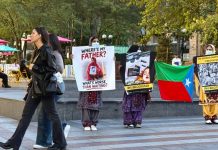
When Baloch Yakjehti Committee (BYC)’s members face arrests, their greatest crime is not holding banners or chanting slogans. Their real crime is that they are laying the foundations of a new language. They dare to call abductions “forced disappearances,” killings “genocide,” and exploitation “colonialism.” And this is the crime the state cannot fully punish, even with all its weapons, judges, and intellectuals.
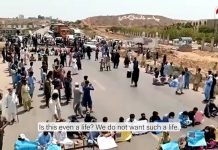
Frantz Fanon said that the greatest struggle of the colonized person is the recovery of their language. This recovery may start with the gun, but it is only complete when language is also freed along with it. The Baloch are fighting on both fronts, with their bodies and their language. When Baloch mothers take to the streets against forced disappearances, the banners they hold are, in fact, new writings of the language.
The fear reflected in the Pakistani Army Chief’s speech is a result of this recovery. When he says that “ten generations cannot succeed in Balochistan,” he is actually admitting that the defeat in the war of meaning is so complete that even generations won’t be able to control it. The freedom of language is independent of time. And no gun, no court, no army chief can defeat the language that is being sowed by mothers, by sisters standing over the corpses, by the youth writing their thoughts in the prisons. That language will not be defeated.
This is the moment when the gun and language become protectors of each other. The gun is protecting those words the state wishes to erase, and those words are giving meaning to the bodies that stand proudly before the guns. Now, language and resistance are inseparable. Neither language can survive without resistance, nor can resistance live without language.
At this point, the question of the gun takes on a new significance. The gun is no longer just a tool for physical defense, but it has become the guardian of language’s survival. If we are to protect language from the enemy’s symbolic assault, the gun’s duty is not only to defend bodies but also to protect language and consciousness. If language is wounded, the gun too becomes meaningless, for the gun of a people whose language is defeated will eventually be labeled as terrorism in the colonial tongue.
We must remember the history of Algeria. They won the war, drove out the French army, but lost the battle of language. Today, Algeria’s official administration, education, and courts remain entrenched in the French language and mindset. The land of freedom was taken, but the meanings are still colonial. The same tragedy occurred in Latin America, where the Spanish occupation ended, but the way of thinking, writing, and the language of law remained confined to the colonial structure. An enslaved mind was kept within a free body.
The same plan is underway with Balochistan. The Pakistani state knows it cannot put checkpoints on every mountain, but it can certainly guard every word. This is why resistance is now labeled as terrorism, BYC as extremism, and Baloch youth as agents of RAW. This is a war of symbols, where only the one who frees their language, their meanings, and their questions from the enemy’s concepts will emerge victorious.
The gun and language both have a sacred mission: to keep life, truth, and identity free. The day language is lost, the gun will lose its direction too, and the day language survives, even if there are piles of corpses, the nation will still be alive.
History is not always written by those nations who get lost in the intoxication of victory, but by the hands that, even under the rubble of defeat, manage to save their language, their voice, and their truth. The Baloch nation, which has been threatened by bullets, erased from textbooks, and distorted in media narratives, today stands at the heart of this intellectual storm, declaring that our struggle is not just for the reclamation of land but for the reclamation of meaning. The gun saves the body; language frees the soul. And the day a nation frees its language from the shadow of its enemies, that moment will become the first letter of an unbreakable freedom in its history.
We are the nation that has drawn its language from burning homes, missing corpses, and blood-stained paths; we have shattered every colonial metaphor of the enemy with the blow of our consciousness; we have realized that the shine of the state’s words is nothing but the crumbling buildings of lies. Now we have carved words from our blood that will neither bow, nor sell, nor perish. This is our true front, a war fought not just in the mountains but in the depths of minds; a resistance that goes beyond the roar of guns and resonates in every particle of language. And when the world turns the pages of history, it will see that the Baloch nation not only defended its land but immortalized its existence by saving its language. Because in the end, language is the last fortress where nations declare their freedom.
Disclaimer: The views and opinions expressed in this article are those of the author and do not necessarily reflect the official policy or position of The Balochistan Post or any of its editors.